Flatbed Towing in Giles County, TN — When You Need It and Why
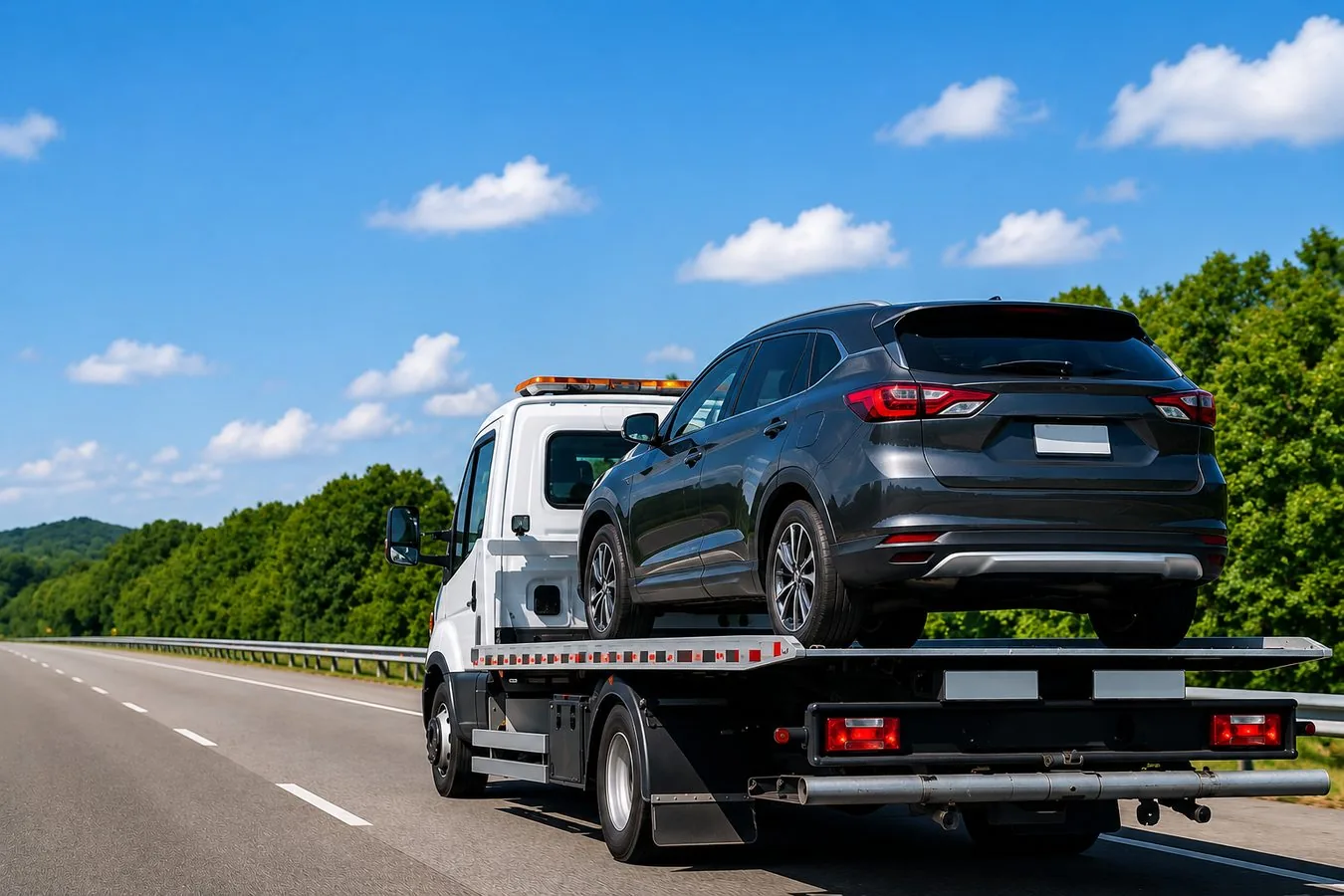
If your car is stuck on the shoulder of US-31 or sitting dead in a parking lot off the Pulaski square, the type of tow truck that shows up matters more than most drivers realize. A flatbed tow — sometimes called a rollback — carries your entire vehicle up off the road on a flat steel deck. Nothing drags, nothing spins, and nothing scrapes. For a lot of situations here in Giles County, that is exactly what your vehicle needs, and choosing the wrong kind of tow can turn a simple breakdown into an expensive repair.
At Pulaski Towing we run flatbed trucks 24/7 across Pulaski and the surrounding towns, and we get asked all the time: do I really need a flatbed, or will a regular wheel-lift do? This guide walks you through exactly when flatbed towing is the right call, why it protects your car, and what to expect when you call us out to a stretch of US-64 at two in the morning.
What flatbed towing actually is
A flatbed truck has a long, flat bed that hydraulically tilts and slides down to ground level. Your vehicle is winched or driven onto the deck, secured with straps or chains, and then the whole deck levels back out and locks into place. The key difference from other methods is simple: all four of your wheels leave the pavement. The car rides on the truck, not behind it.
Compare that to a wheel-lift tow, where a metal yoke cradles two of your tires and lifts that end of the car while the other two wheels roll along the road. Wheel-lift towing is faster to hook up and perfectly fine for many vehicles, especially short moves. But it leaves two of your wheels — and your suspension, axles, and transmission — connected to the road the entire trip. For some cars that is a problem, and that is where the flatbed earns its keep.
When you need a flatbed in Giles County
There are specific situations where we will always recommend a flatbed over a wheel-lift, and most of them come up regularly on the roads around Pulaski:
- All-wheel-drive and four-wheel-drive vehicles. Towing an AWD vehicle with two wheels on the ground can damage the drivetrain and transfer case. A flatbed keeps every wheel off the road, which is why owner's manuals for most AWD crossovers and trucks specifically call for flatbed transport.
- Low-clearance and luxury cars. Sports cars, lowered vehicles, and many newer sedans have front bumpers and air dams that scrape on a wheel-lift. A flatbed loads at a gentle angle and protects that expensive bodywork.
- Accident vehicles. If a car was in a collision and the wheels, axles, or steering are damaged, it may not roll safely at all. A flatbed lets us winch it on and haul it without forcing damaged components down the highway.
- Long-distance tows. Heading from Pulaski to a dealership in Columbia or Huntsville? The longer the trip, the more a flatbed makes sense — there is simply less wear and zero road miles added to your vehicle.
- Motorcycles, classic cars, and anything irreplaceable. When a vehicle can't take any chances, the flat deck and soft-strap tie-downs are the safe answer.
If you are not sure which category your vehicle falls into, just tell us the year, make, and model when you call. We have hauled just about everything on the roads of Giles County, and we will tell you honestly whether a flatbed or a wheel-lift is the smarter, cheaper choice for your specific situation.
Why flatbed towing protects your vehicle
The whole point of a flatbed is to eliminate road contact. When your car rides flat on the deck, there is no rotation in the wheels, no strain on the transmission, no flex through the suspension, and no chance of the undercarriage dragging over a pothole on Sam Davis Avenue. For modern vehicles packed with sensors, electronic parking brakes, and sealed drivetrains, that protection is worth a great deal.
It also matters for safety. A securely strapped vehicle on a flat steel deck is one of the most stable ways to move a car at highway speed. According to the National Highway Traffic Safety Administration, properly securing a vehicle for transport is critical to preventing road incidents — and a flatbed with four points of tie-down does exactly that. When we load your car, we are not just hooking it up and going; we strap it down to DOT compliant standards every single time.
Every Pulaski Towing operator is licensed and insured, and our flatbeds are inspected and maintained so the equipment you are trusting with your vehicle is in solid shape. That is not marketing — it is the baseline for doing this job right in a small community where word travels fast.
Flatbed vs. wheel-lift: a quick comparison
Both methods have their place. Here is how they stack up for the kinds of calls we run around Pulaski:
| Situation | Best method |
|---|---|
| AWD or 4WD vehicle | Flatbed |
| Standard front-wheel-drive, short move | Wheel-lift is fine |
| Low or lowered car | Flatbed |
| Accident or non-rolling vehicle | Flatbed (with winch-out) |
| Long-distance haul | Flatbed |
| Quick repo-yard or in-town reposition | Wheel-lift |
Notice the winch-out note next to accident vehicles. When a car has slid off the road into a ditch along Lynnville Highway or gotten stuck in soft ground, we use a winch to pull it up onto the flatbed before transport. That combination of winch-out recovery plus flat-deck hauling is one of the most common calls we run in the rural stretches of the county.
What to expect when you call Pulaski Towing
When you reach us at (931) 286-7805, here is how a flatbed call typically goes. First, we get your location — a cross street, a mile marker on I-65, the nearest landmark like the Giles County Courthouse, or even a dropped pin. Then we ask about the vehicle so we send the right truck the first time. We give you an honest, up-front price and a realistic arrival window. Across Pulaski and Giles County our typical response time is 30 to 45 minutes, and because we run 24/7, that holds whether it is rush hour or the middle of the night.
When the flatbed arrives, the operator will assess how the car needs to be loaded, position the deck, and winch or drive it on at a safe angle. Your vehicle gets strapped down, and we confirm the destination with you before we pull away. If you are riding along, there is room in the cab. If you are arranging to meet the car at a shop, we will keep you posted on the drop-off.
We serve Pulaski, Cornersville, Lynnville, Ardmore, Elkton, Minor Hill, and Fayetteville, plus the highways that connect them — US-31, US-64, TN-11, and the I-65 corridor. ZIP 38478 and the surrounding rural routes are home turf for our drivers, so you are not waiting on a truck coming from two counties over.
Need a flatbed in Giles County?
24/7 flatbed towing across Pulaski and the I-65 corridor. Licensed, insured, and honest about pricing — every time.
📞 Call (931) 286-7805Frequently asked questions
Is flatbed towing more expensive than regular towing in Giles County?
Flatbed towing can cost a little more than a basic wheel-lift hook because it ties up a larger truck and takes more time to load. For most cars in Giles County the difference is modest, and it is often worth it to avoid drivetrain or bumper damage. We give an honest price up front before we ever load your vehicle, so there are no surprises when you call (931) 286-7805.
How fast can you get a flatbed to me on US-31 or I-65?
Our typical response time across Pulaski and Giles County is 30 to 45 minutes, and we run 24/7. If you are stranded on US-31, US-64, or the I-65 corridor near Ardmore, call us right away and we will dispatch the closest flatbed and give you a realistic arrival window so you know exactly what to expect.
Have you ever had a car damaged by the wrong kind of tow? We would rather get you the right truck the first time.